Who commissioned the Requiem?
Count Walsegg, anonymously and through an intermediary, in memory of his wife Anna, who died at twenty.
The Requiem was commissioned anonymously, through an intermediary.
The patron was Count Franz von Walsegg. He wanted a mass in memory of his wife Anna, who had died in February 1791 at twenty, and he had a habit of buying other people's music to pass off as his own. So the letter and the money came through an intermediary, and Mozart most likely never knew the count's name.
Source: Anton Herzog's memoir, 1839; NMA critical report.
Which opera did Mozart write in the same year, 1791?
The Magic Flute, premiered on 30 September 1791. The same year also brought La clemenza di Tito for Prague.
Mozart believed he was writing the requiem for his own death.
That is how Constanze told it, and how the biographer Niemetschek wrote it down in 1798, seven years after the death. There is no other witness. The 'grey messenger' who keeps returning to remind him of the commission comes from the same source. A fine story, but there is no way to check it.
Source: Niemetschek, Life of Mozart, 1798.
How old was Mozart when he died?
Thirty-five. He was born on 27 January 1756 and died on 5 December 1791.
The day before he died, Mozart sang the Requiem with friends and wept at the Lacrimosa.
The singer Benedikt Schack told the story in 1827, thirty-six years later. On 4 December, he said, Mozart, Schack, Hofer and Gerl sang through the finished movements, and at the Lacrimosa Mozart put the music aside. It is the only source, and a late one. It may be true, or a memory that changed over the years.
Source: Schack's obituary, Allgemeine musikalische Zeitung, 1827.
Salieri poisoned Mozart.
There is no evidence. The physician recorded the cause of death as 'severe miliary fever', which in the language of the time meant a high fever with a rash. Rumours of poisoning went round Vienna in the 1820s, and the elderly Salieri denied them. The story spread widely through Pushkin's short play Mozart and Salieri (1830), then Shaffer's play and the film Amadeus (1984).
Source: Vienna death register, 5 December 1791; Pushkin, 1830; Shaffer, 1979.
Mozart's Requiem was performed at his funeral.
There was no music at the funeral on 6 December at St. Stephen's: a short rite by the chapel. But on 10 December a memorial service was held at St. Michael's, arranged by Schikaneder, and the finished movements, the Introitus and Kyrie, were performed there. That is the first known performance of any part of the Requiem.
Source: Memorial plaque and records of St. Michael's, Vienna.
Mozart was buried in a pauper's grave.
The burial was an ordinary third-class one under Emperor Joseph II's rules: no headstone, several bodies to a pit, no procession to the cemetery. Most Viennese were buried that way. Not a pauper's grave, but the site really was lost; the monument at St. Marx cemetery marks an approximate spot.
Source: St. Stephen's burial register; Braunbehrens, Mozart in Vienna.
Where does Mozart's manuscript break off?
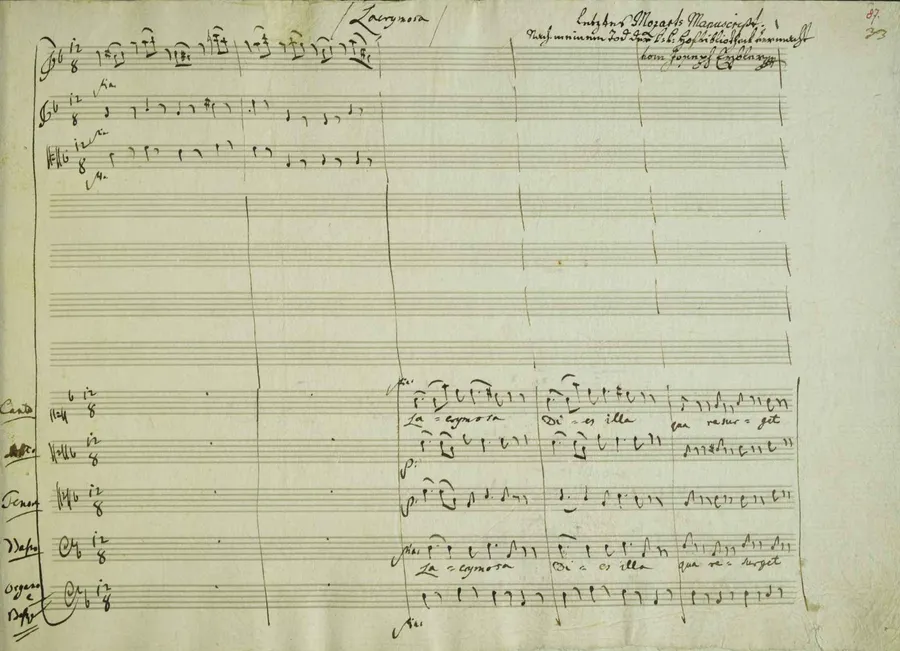
In the Lacrimosa, after bar eight, at the words 'judicandus homo reus'. Everything after is Süssmayr.
The last thing Mozart wrote in the score was the Lacrimosa.
Unknown. The Lacrimosa manuscript stops after bar eight, and it looks like an ending. But the Hostias is written out to the end, with 'Quam olim da capo' in the margin, and the order in which he worked on the movements is not documented. Either leaf could be the last.
Source: Autograph, Austrian National Library, Mus.Hs. 17561.
What happened to the bottom right corner of the last Hostias page?
At the 1958 World's Fair in Brussels someone tore off the corner with the words 'Quam olim da Capo'. The piece was never found.
Mozart's pupil finished the Requiem.
Constanze needed the fee, so the work had to be completed. She first turned to Joseph Eybler, who orchestrated part of the sequence and stopped. Then Franz Xaver Süssmayr, Mozart's twenty-five-year-old pupil and assistant, took over. He completed the Lacrimosa, wrote the Sanctus, Benedictus and Agnus Dei, and brought the opening music back for the ending.
Source: Süssmayr's letter to Breitkopf & Härtel, 1800.
The score delivered to the patron carries Mozart's signature.
It does, but it is not his. The title page reads 'di me W. A. Mozart 1792': Süssmayr wrote the signature and the date in imitation of his teacher's hand, after Mozart's death. The patron was to receive a work by Mozart, and so he did.
Source: The delivery score; NMA critical report.
When was the Requiem first performed in full?
On 2 January 1793 in Vienna, at a benefit concert for Constanze. Walsegg performed it as 'his own' only in December 1793.
Count Walsegg performed the Requiem as his own work.
He did. He copied the score in his own hand and conducted it as its author in Wiener Neustadt on 14 December 1793. But the Requiem had already been heard earlier, on 2 January 1793 in Vienna, at a benefit concert for Constanze. Walsegg was neither the first nor the only one to hear it.
Source: Anton Herzog's memoir, 1839.
How many movements does the Requiem have in Süssmayr's version?
Fourteen movements in eight sections. Levin's edition adds a fifteenth, the 'Amen' fugue.
Which instruments are absent from the Requiem orchestra?
Flutes and oboes, the brightest of the woodwinds. Basset horns take their place, hence the dark sound.
What language is the Kyrie text in?
Greek: 'Kyrie eleison', 'Lord, have mercy'. It is the oldest layer of the liturgy, left untranslated.
What do the first and last movements have in common?
The Lux aeterna repeats the music of the Introitus and the Kyrie fugue note for note, with words about eternal light. The work closes into a circle.
Summary
0of 20
Of the 10 stories told most often about the Requiem, only 4 are true. The rest was written by imagination: a widow's, the biographers', Hollywood's.
- 01 Who commissioned the Requiem? Answer: Count Franz von Walsegg Your answer:
- 02 The Requiem was commissioned anonymously, through an intermediary. Fact
- 03 Which opera did Mozart write in the same year, 1791? Answer: The Magic Flute Your answer:
- 04 Mozart believed he was writing the requiem for his own death. Not proven
- 05 How old was Mozart when he died? Answer: 35 Your answer:
- 06 The day before he died, Mozart sang the Requiem with friends and wept at the Lacrimosa. Not proven
- 07 Salieri poisoned Mozart. Myth
- 08 Mozart's Requiem was performed at his funeral. Myth
- 09 Mozart was buried in a pauper's grave. Myth
- 10 Where does Mozart's manuscript break off? Answer: In the Lacrimosa, after bar eight Your answer:
- 11 The last thing Mozart wrote in the score was the Lacrimosa. Not proven
- 12 What happened to the bottom right corner of the last Hostias page? Answer: It was torn off and stolen at an exhibition in 1958 Your answer:
- 13 Mozart's pupil finished the Requiem. Fact
- 14 The score delivered to the patron carries Mozart's signature. Fact
- 15 When was the Requiem first performed in full? Answer: On 2 January 1793 in Vienna Your answer:
- 16 Count Walsegg performed the Requiem as his own work. Fact
- 17 How many movements does the Requiem have in Süssmayr's version? Answer: 14 Your answer:
- 18 Which instruments are absent from the Requiem orchestra? Answer: Flutes and oboes Your answer:
- 19 What language is the Kyrie text in? Answer: Greek Your answer:
- 20 What do the first and last movements have in common? Answer: The ending repeats the opening music with new words Your answer: