




A Warsaw newspaper called the concerto 'a work of genius' before the public had heard it.
It did. On 22 September 1830 Chopin played the concerto with an orchestra for the first time - at home, for invited Warsaw musicians. Two days later the newspaper Krajowy Dziennik Powszechny wrote: 'it is a work of genius', and added, about the composer who was about to go abroad: 'Let us hope that no foreign capital will keep him for ever.' The premiere was still two and a half weeks away.
Source: Krajowy Dziennik Powszechny, 24 September 1830, after the chronology of Chopin's life in Encyklopedia Muzyczna PWM.
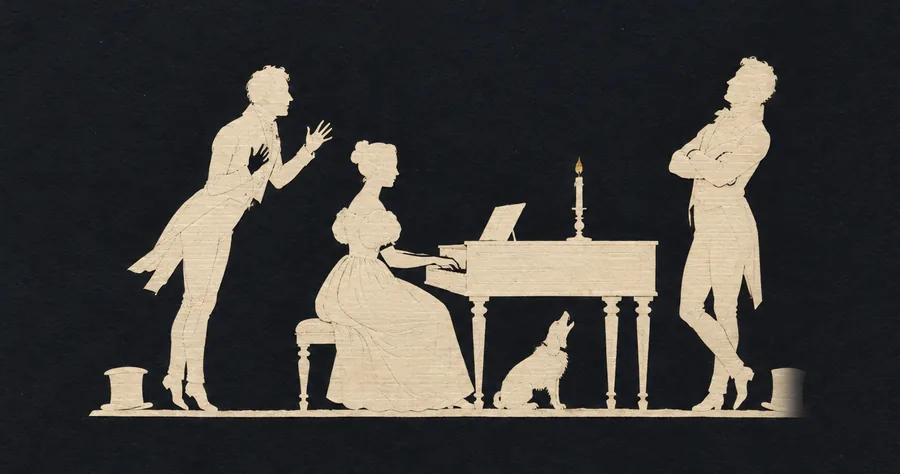
For two students to sing at Chopin's concert, a minister's permission was needed.
It was. Chopin did not want wind players to perform solos between his own appearances at the piano - 'those wretched clarinets or bassoons', as he wrote to his friend. In their place he invited Anna Wołków and Konstancja Gładkowska, who were studying singing at the Warsaw conservatory. Both were educated at the state's expense, so the permission had to come from Minister Mostowski himself.
Source: Chopin's letter to Tytus Woyciechowski, 5 October 1830; Frederick Niecks, biography of Chopin, 1888.
How many listeners came to the premiere of the concerto on 11 October 1830?
About 700 - that is the number given by the newspaper Kurier Warszawski. Chopin wrote to his friend 'full hall', but his two concerts in March of the same year had drawn more people: 800 and nearly 900.
Chopin's words about 'my ideal, whom I faithfully serve' are about the slow movement of this concerto.
No, they are about another concerto. On 3 October 1829 Chopin wrote to Tytus that he had 'my ideal, whom I faithfully serve', and that in memory of it 'the adagio of my concerto came into being'. At that time he was working on the Concerto in F minor; he began the E minor only in the spring of 1830. The letter gives no name; biographers believe it means Konstancja Gładkowska, who was then studying singing at the Warsaw conservatory.
Source: Chopin's letter to Tytus Woyciechowski, 3 October 1829.
The Romance, the slow movement of the concerto, is a musical portrait of Konstancja Gładkowska.
Many biographers say so, but it is their conclusion, not Chopin's words. The letter of 15 May 1830, where he describes this movement in detail, does not mention Konstancja's name. There is only a hint: 'something has crept into my head through my eyes, against my will, and I love to cherish it'. Whom or what he means, the letter does not show.
Source: Chopin's letter to Tytus Woyciechowski, 15 May 1830.
A week before Chopin left, Konstancja wrote a poem in his album: strangers may value you better, 'but love you more than we do they surely cannot'. What did Chopin later add beneath these lines?
Two words in English, one in Polish: 'they can'. Konstancja wrote the poem on 25 October 1830, and on 2 November Chopin left Warsaw. When exactly he added the word, we do not know.
At his farewell Chopin's friends gave him a silver cup of Polish soil, and that soil was later scattered on his coffin.
We know this story from a single source - the book by Maurycy Karasowski, a biographer of Chopin, published in 1877, twenty-eight years after his death. Karasowski reworked even the texts of Chopin's letters, so it is hard to take him at his word. There is no cup in Chopin's own letters. An eyewitness of the funeral, whose account was printed in the journal The Musical World, does not mention any soil either. Something else is certain: his friends saw Chopin off outside the city with a cantata written for the occasion by his teacher Józef Elsner.
Source: Karasowski, 1877; Frederick Niecks, biography of Chopin, 1888; Kurier Warszawski, 3 November 1830.
In Wrocław, on the way from Warsaw to Vienna, Chopin's playing was praised, and of his music one listener said: 'He can play, but he cannot compose.'
True, and Chopin himself reported it in a letter to his family. On 8 November 1830 he stood in for a local amateur at a concert and played the Romance and the finale. The German musicians marvelled at 'what a light touch he has', and said nothing about the piece. The words about composing were overheard in the hall by Tytus.
Source: Chopin's letter to his family from Wrocław, 9 November 1830.
How many times, as far as we know, did Chopin play this concerto in public?
Six performances are certain: Warsaw and Wrocław in 1830, Vienna and Munich in 1831, Paris in 1835 and Rouen in 1838. The seventh is the Paris debut of 1832, on which the accounts disagree. We know of no later public performances.
After the concert in Rouen in 1838 Ernest Legouvé, who reviewed it for the Paris Gazette musicale, gave his own answer to a question much argued over at the time: who is the first pianist in the world - Liszt or Thalberg? Whom did he name?
'There is only one answer: Chopin.' In Rouen on 12 March 1838 the E minor concerto was warmly received. Three years earlier, in a large Paris hall, the same music had met with coldness: according to recollections of the time, only friends and a few connoisseurs applauded.
Chopin's own music was also heard at his funeral.
It was. The coffin was carried into the church to his Funeral March from a piano sonata, arranged for orchestra for the occasion by Henri Reber. Two of Chopin's preludes, in E minor and B minor, were played on the organ. The player was the church's organist, Lefébure-Wély - the same man who, as a student, had performed the Concerto in E minor when he took his diploma.
Source: Correspondent of The Musical World, 10 November 1849, after Niecks's biography; Encyklopedia Muzyczna PWM.
To find out what Chopin died of, scientists opened the vessel holding his heart.
No. On 14 April 2014 researchers examined the heart without opening the vessel. Michał Witt's team concluded that the most likely immediate cause of death was a complication of tuberculosis, an inflammation of the membrane around the heart. The conclusion was published in the American Journal of Medicine.
Source: Science in Poland, on the study by Michał Witt's team.
Summary
0of 12
A first rehearsal
The legends about Chopin are told with confidence, and today they sounded more convincing than the letters. Now you know where to look for the truth.
Of the 8 stories about this concerto we checked here, the letters and documents bear out 4. The rest was added by biographers - often decades later.
- 01A Warsaw newspaper called the concerto 'a work of genius' before the public had heard it.Fact
- 02For two students to sing at Chopin's concert, a minister's permission was needed.Fact
- 03How many listeners came to the premiere of the concerto on 11 October 1830?Answer: About 700Your answer:
- 04Chopin's words about 'my ideal, whom I faithfully serve' are about the slow movement of this concerto.Myth
- 05The Romance, the slow movement of the concerto, is a musical portrait of Konstancja Gładkowska.Not proven
- 06A week before Chopin left, Konstancja wrote a poem in his album: strangers may value you better, 'but love you more than we do they surely cannot'. What did Chopin later add beneath these lines?Answer: 'They can'Your answer:
- 07At his farewell Chopin's friends gave him a silver cup of Polish soil, and that soil was later scattered on his coffin.Not proven
- 08In Wrocław, on the way from Warsaw to Vienna, Chopin's playing was praised, and of his music one listener said: 'He can play, but he cannot compose.'Fact
- 09How many times, as far as we know, did Chopin play this concerto in public?Answer: Six or sevenYour answer:
- 10After the concert in Rouen in 1838 Ernest Legouvé, who reviewed it for the Paris Gazette musicale, gave his own answer to a question much argued over at the time: who is the first pianist in the world - Liszt or Thalberg? Whom did he name?Answer: ChopinYour answer:
- 11Chopin's own music was also heard at his funeral.Fact
- 12To find out what Chopin died of, scientists opened the vessel holding his heart.Myth
This site is open and free. Support the project →