






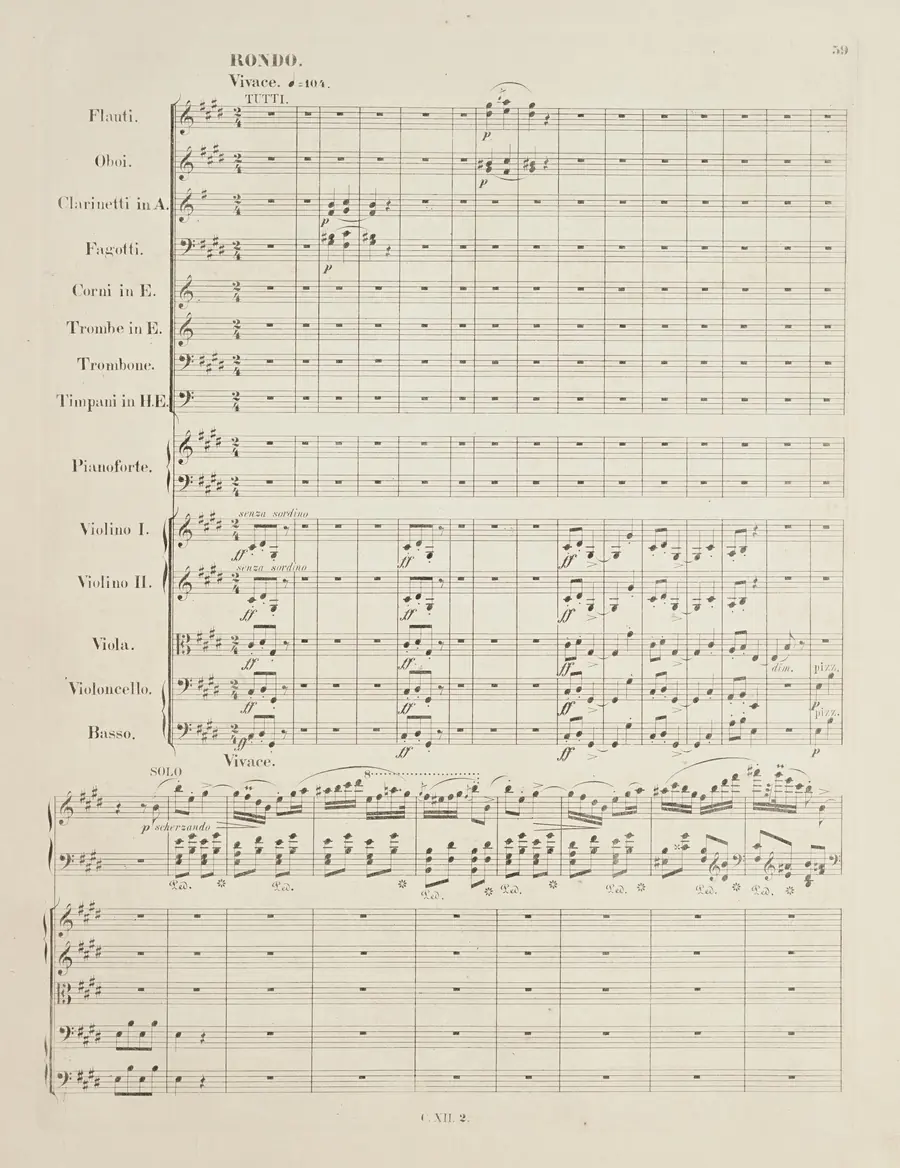
The 1880 score: Rondo
The first page of the finale. It follows the Romance with no pause and has the rhythm of the krakowiak, a quick dance from the Kraków region.
Tap an area on the page or an item in the list.
About
The finale begins straight after the Romance, without a pause: a moment ago it was a moonlit night, and now it is morning. The piano leads a light dance tune that comes back several times, and between its returns it plays faster and faster passages. Chopin himself summed the movement up in one word - "effective" - and at the rehearsals it was the one the listeners liked best.
The main tune of the finale is light and dance-like. The piano plays it at the very start, and it is repeated several more times, so we quickly get used to it.
Catch the moment in the middle of the movement: the tune begins again but sounds a little lower than before - as if the pianist had set the hands one key to the left. Some ten seconds later it rises back to its usual place just as suddenly. Chopin's biographer Frederick Niecks called such places "sly surprises".
Listen for this
Places worth hearing on their own
0:00 – 0:17
Waking up
After the quiet end of the Romance the orchestra wakes us at once with a sharp dance rhythm.
Worth knowing
The Rondo was the hardest part for Chopin: in May 1830 he wrote that it was not finished, "and for that you need inspiration". He completed it only in August.
At the home rehearsal the listeners liked the finale best - "because it is the easiest to understand", as Chopin reported.
The finale's tune has the rhythm of the krakowiak, a quick dance from the Kraków region in which the accent often falls where you do not expect it. Chopin had written such a dance before: the "Rondo à la Krakowiak", which he played in Vienna in 1829 and in Warsaw in the spring of 1830.
Twenty-seven days after Chopin left, an uprising against the Russian Empire broke out in Warsaw. He was in Vienna and never returned to Poland.
The loudest applause at the premiere went not to the concerto but to the Fantasy on Polish Airs, with which Chopin closed the evening: he was called back and, in his own words, “had time to bow four times”. About how the Romance and the finale were received, his letter says nothing at all.
On 2 November 1830, as Chopin was leaving Warsaw, his friends saw him off beyond the city gate with a cantata written for the occasion by his teacher, Józef Elsner.
In the final of the Chopin Competition in Warsaw each pianist plays one of his two concertos with orchestra, by choice. Nearly everyone takes this one: in 2015 nine finalists out of ten did. But the 2025 winner, Eric Lu, played the other one, in F minor.
Conversation
What you heard
Share your impressions of what you heard, your feelings, or simply your thoughts out loud.
Only for the name under your comment. Your email is shown to no one.
Quiet here so far. Yours would be the first.